The Power of Play: Breaking Barriers and Building Community
In one of our popular spotlight calls, Emma Bearman from Playful Anywhere explored how play functions as a quiet revolutionary tool - a Trojan horse that dissolves barriers between strangers and creates space for collective imagination.
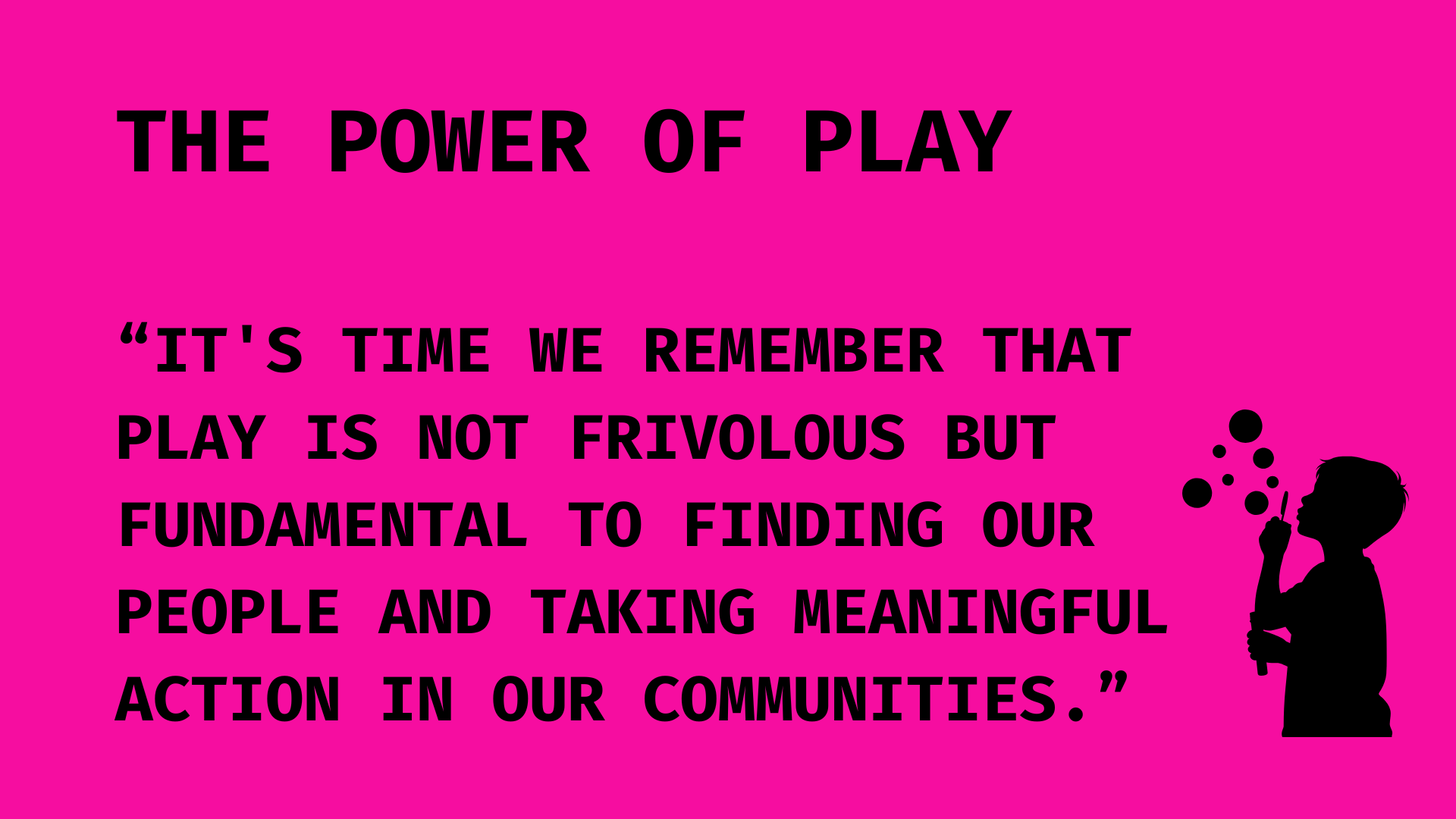
It's time we remember that play is not frivolous but fundamental to finding our people and taking meaningful action in our communities.
Here are the key ideas that we explored during our 2025 spotlight call with Emma Bearman from Playful Anywhere - you can watch the full call here.
Play as a Barrier-Breaker
Emma reminded us that play disarms. Unlike formal activism or community meetings, which can feel intimidating or exclusionary, play invites participation without demanding ideological commitment.
Emma described her mission as "if we can imagine it together, we can make it" - a philosophy that hinges on collective imagination as something we urgently need in these times. When people play together, they shed their armour. A chalk drawing on a pavement, mud pies, or bubbles don't require membership, credentials, or prior knowledge. They just require presence and curiosity.
This accessibility can be transformative. Play happens in the gaps of ordinary life - on the school run, in the park, on your street. It doesn't ask permission. It doesn't require funding or special equipment. A stick becomes a walking companion, a crown, or a conductor's baton depending on who picks it up. This unpredictability is precisely what makes play so effective at breaking down the walls we build between ourselves and strangers.
Play as Community Organising - Play is how you find your people.
When someone notices playfulness happening in their neighbourhood -a child building something creative, neighbours lingering in shared spaces - play becomes a language that says "I'm here, I care about this place, and I'm interested in connection." Window signs declaring "Play welcome in this neighbourhood" transform streets into visible communities of practice.
Emma emphasised the power of observation as the first step: noticing where play is already happening, where curiosity is being ignited, and who else is drawn to those spaces.
The second step is catalytic action - doing something small that invites others to join. Taking a chalk for a walk or creating a simp, a playful intervention, doesn't require organisation or coordination. It simply requires the willingness to be visible. These acts of play are magnetic for people turning strangers into collaborators.
Play for Parents, Teachers, and Community Members
For adults - parents, teachers, and community organisers - play offers a permission slip to slow down and create space for imagination alongside those we care for. In a world obsessed with productivity, play is radically counter-cultural. It signals that we believe imagination matters, that relationships matter more than efficiency, and that joy is not a luxury but a necessity.
Parents and educators can model this. When adults play, we show children that play belongs to all of us, not just the young. We demonstrate curiosity and openness. We create conditions in which others feel safe to be playful, too. Teachers and those looking to connect with others in our communities can use play as a gateway into deeper conversations and connection - it's often easier to talk about what matters whilst doing something together than sitting across a desk.
Where Play Leads
The real power emerges in the collective.
Individual acts of play - noticing, inviting, participating - create the fabric of communities where people know one another, trust one another, and eventually organise together. Play is where that journey begins. It's the Trojan horse that carries something essential into spaces where walls once stood.
Ready to ACT? Play-Based Actions to Try in Your Community
Observe and Notice Start by noticing where play is already happening in your neighbourhood or workplace. What traces of playfulness can you spot? Where is curiosity being ignited? Who else seems drawn to those spaces? Keep field notes of what you discover.
Take a Talk for a Walk: Invite someone to talk whilst doing something playful together—walking, drawing with chalk, making something in mud. Conversations flow differently when you're not facing each other across a table. You don't need to hashtag it or announce it; just do it and see what emerges.
Find Your Stick: Identify something simple and tactile that brings you joy and resets your mood when the world feels overwhelming - a walking stick, a piece of driftwood, a smooth stone. Use it as a companion and an invitation for others to engage with play.
Create a "Play Welcome" Sign: Display a window vinyl or handmade sign in your window saying "Play welcome here" or "Play welcome in this neighbourhood." This is a visible signal that you're part of a community that values play and invites others to join.
Connect Street Play: Look into local street play initiatives or create your own informal spaces where children and adults can play together without permission or formal organisation. Simple things like chalk, bubbles, or building materials can transform a pavement.
Slow Down and Imagine Together: Create intentional space - even just 15 minutes - where you and others (family, colleagues, neighbours) can imagine something together without worrying about productivity. What could you make? What could you build? What would you dream up if there were no rules?
Invite Playful Action: Do something small and playful in your community, then step back and notice what happens. Does it catalyse others to join? Do conversations start? Play is contagious.
Document and Share: Collect stories and observations from play happening around you. Share them with your community. Show others that play is real, valuable, and already happening in their communities.
Playful Anywhere is a Leeds-based social enterprise with a mission to catalyse creativity, inventiveness and playfulness, where we work, live and travel. Find out more about their work here.