Something to watch: How Two Parents Are Transforming Party Culture: Lessons from Party Kit Network and No Crap Parties
In a recent Actionism Spotlight session, Isabelle Mack from Party Kit Network and Charlotte Mason-Kerr from No Crap Parties shared their inspiring journeys of tackling waste in children's celebrations.
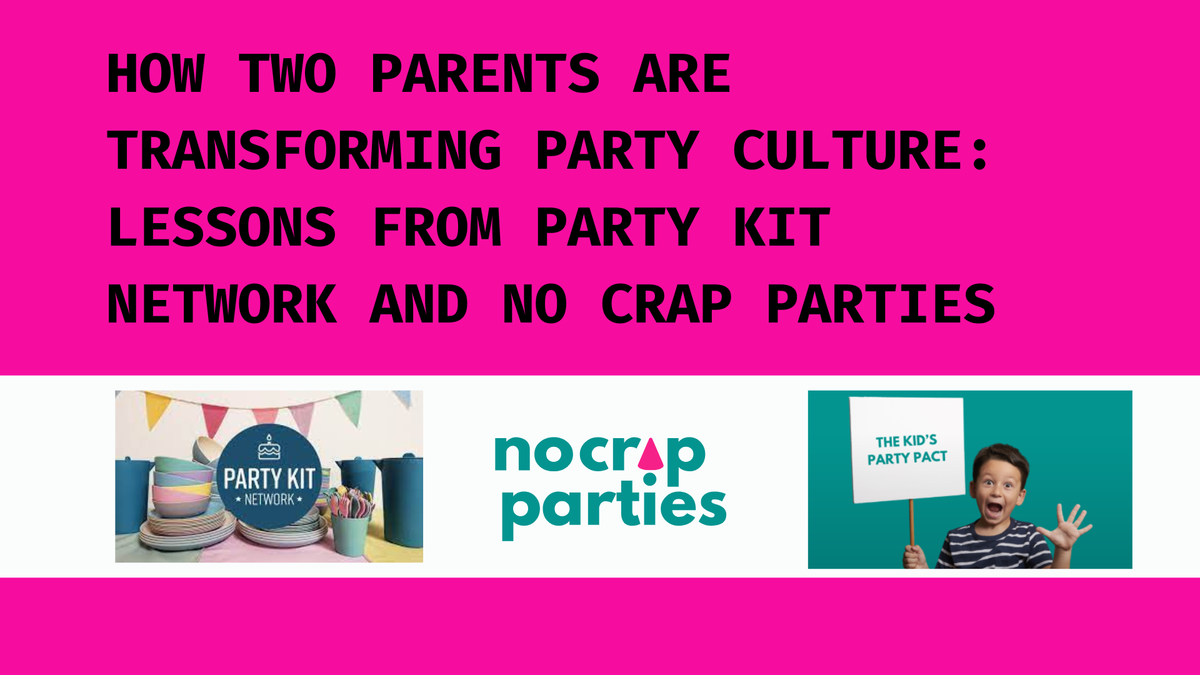
In a recent Actionism Spotlight session, Isabele Mack from Party Kit Network and Charlotte Mason-Kerr from No Crap Parties shared their inspiring journeys of tackling waste in children's celebrations.
You can watch the whole 45-minute interview here
or read the highlights of our chat, all you might want to know about their movements and how to get involved
The Problem
Both initiatives address the enormous waste generated by children's parties: single-use plates and cups, plastic party bag tat, and unnecessary gifts that end up in landfills. But more importantly, they're challenging cultural norms around how we celebrate.
Three Ways to Take Action Right Now
If you're hosting or attending a party, the No Crap Party Pact offers three simple steps (you don't have to do all three):
1. Ditch the plastic party bags. Use secondhand items, homemade treats, or sustainable alternatives instead of single-use tat.
2. Offer gift guidance on invites. Simply suggest "no gifts necessary," request secondhand items, or ask guests to contribute towards an experience or charitable donation.
3. Give more sustainably. When bringing a gift, opt for pre-loved, homemade, or experiential gifts rather than new plastic toys.
Party Kit Network complements this by making reusable tableware accessible -you borrow plates and cups rather than buying disposables.
How They Got Started (And You Can Too)
Isabele's journey began with a friend's Facebook post about plastic-free toilet roll. That sparked enough curiosity to lead her to Jen Gale's Sustainablish podcast about party kits. Within weeks of posting in a local parents' Facebook group asking "Does anyone know of a party kit near here?", she'd found one, learned how it worked, and decided to offer one herself. The growth was rapid: 40 members by August, 250 by Christmas. By the pandemic, she'd registered Party Kit Network as a Community Interest Company (CIC).
Charlotte's awakening came through climate literacy training that made her realise the future impacts on her children. After organising toy swaps for four years, she attended a "sustainable" friend's party where plastic party bags were handed out—that was her tipping point. Using her marketing background, she created a website, launched on Instagram, crowdfunded £1,600, then secured a lottery grant of nearly £10,000. She's now also registered as a CIC.
The key lesson? Both started by identifying a specific problem they cared passionately about, then leveraged the skills they already had.
The Tricky Bits (& how both Isabell and Charlotte are managing them)
Social pressure is real
Parents worry about being judged for going against convention. Both founders have experienced this, particularly in new social groups like school WhatsApp chats. Charlotte's solution: find an ally first. Before posting to her daughter's class group, she asked a friend to review her message and commit to responding positively. This prevented silence and gave her confidence. The reality? Most people secretly agree with you but won't be the first to say so.
Building community is harder than you'd think
Isabele discovered that communities are surprisingly disconnected. She's only recently, after running her own kit since 2019, had multiple kits out every weekend—and only because she started attending physical spaces: Parents for Future meetups, council meetings, local events. The digital work alone wasn't enough.
Funding is a genuine challenge
Neither project has significant income. Isabele spends roughly £2,000 annually (mostly website costs and software), covering it through donations, her local party kit's income, and occasional speaking fees. All team members work for free. Charlotte raised funds through crowdfunding and a lottery grant covering roughly one day a week of her time—nowhere near what she actually spends. Both struggle to balance their unpaid passion projects with paid work.
Measuring impact is harder than counting signatures
Charlotte initially stressed about pact signatures, but realised the real impact lies in the ripple effects—the conversations happening, the stories coming back from parents, the culture shift.
Isabele sees this too: party kit members she'll never know about, people discovering local sharing libraries through searching for party kits, and behaviour changes spreading beyond what's visible.
What's next?
Both are intentionally staying focused rather than chasing shiny new ideas
Party Kit Network's focus for the coming year: PKN want to help existing kit runners get their kits used more frequently, and develop a sustainable funding strategy that could eventually become her paid role. She's deliberately not expanding the mission - the network doesn't need more features, just better use of what exists.
No Crap Parties are trying to secure funding to cover dedicated time (Isabele currently spends about two days a week on this projectt, unpaid). They also plan to develop partnerships and sponsorships with aligned organisations, and eventually broaden the conversation from children's parties to gifting across all occasions.
Want to see the SPOTLIGHT as it happened?
How to Start Your Own Movement
If you've got an idea but feel intimidated by the scale, complexity, or lack of skills, here's what both Isabele and Charlotte recommend:
Start absurdly small. You don't need a website, a CIC status, or a marketing degree. Begin where you are with what you have.
Post in a local Facebook group.
Create an Instagram page.
Organise a coffee morning with interested neighbours.
Know your problem inside out. Isabele suggests you answer: what's the problem you're happy to stand on a soapbox and rant about? That clarity helps you stay focused and helps others understand what you're trying to do.
Use your existing skills. Both have marketing backgrounds, but that's not essential. Can you bake? Organise? Write? Whatever you're good at becomes your contribution.
Find your ally. You don't need to do this alone. Find one person who believes in the idea and can support you (even just by responding positively when you take your first public step).
Ask boldly. Isabele needed an accountant and asked in a Facebook group—someone volunteered her time for five years without ever meeting her in person. Charlotte asked The Times for coverage and got it. If you don't ask, you don't get.
Show, don't tell. Rather than arguing that parties should be different, both show what's possible. They share stories and examples of other parents doing it successfully. Seeing it done builds confidence.
Get into physical spaces. Online work matters, but showing up matters more. Attend local meetings, go to community events, be visible.
The Ripple Effect
Perhaps the most powerful insight: you don't need to build something massive to create change.
One person borrowing a party kit, one parent trying gift guidance, one friend inspired to do the same - these aren't small wins. They're the beginning of culture shift.
As Isabele says, some people start party kits without ever joining the official network. They run them in their school community. That's okay. The waste is still avoided. The conversation is still happening.
If you've been thinking about starting something but felt held back, this is your sign.
The only qualification you need is caring about a problem and a willingness to take one small step.
Your ripples might inspire someone else's waves.
Read our full guide How Ordinary People Start Movements That Actually Change Systems - the ACTIonism guide to starting a movement that creates systemic change when you've no idea where to start.
Want to get involved?
Visit Party Kit Network to find or start a kit near you, or explore their reusable party equipment lending library.
Sign the No Crap Parties Pact to commit to more sustainable gifting and parties.
Or start your own initiative - the world needs more people willing to challenge the status quo.
Want to see the SPOTLIGHT as it happened?